Modern businesses rarely rely on a single software application.
A company may use a CRM for customer management, a payment gateway for transactions, an e-commerce platform for online sales, accounting software for finances, analytics tools for reporting, and mobile applications for customers.
Each tool may work perfectly on its own.
But when these systems don't communicate with each other, businesses often end up manually transferring information from one platform to another.
This creates unnecessary work, increases the possibility of errors, and slows down business operations.
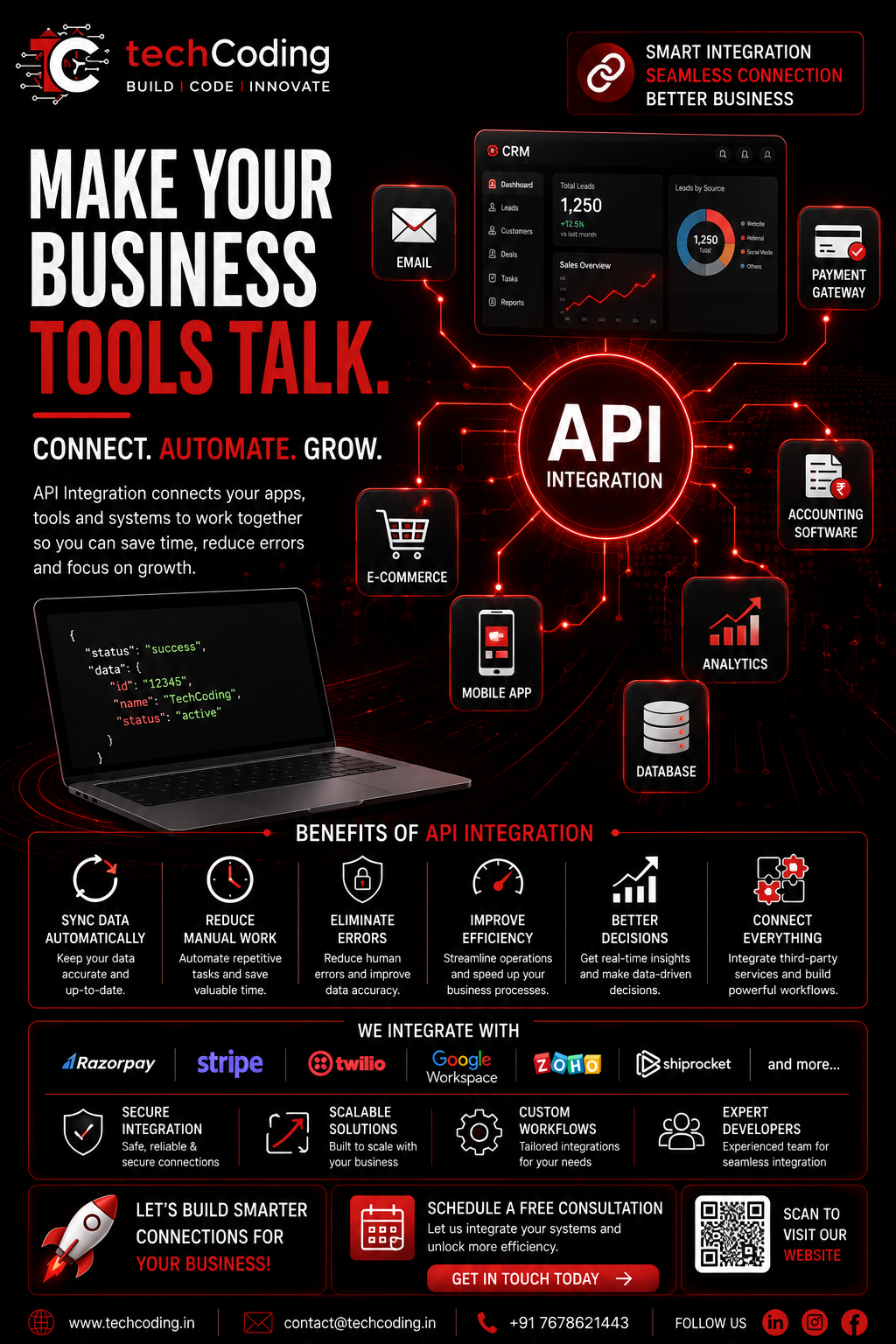
API integration solves this problem by allowing different software systems to communicate and exchange data automatically.
What Is API Integration?
API stands for Application Programming Interface.
An API acts as a communication layer between different software applications.
It allows one application to request information or perform an action in another application without requiring users to manually transfer the data.
For example:
A customer places an order on an e-commerce website.
The system can automatically:
Website → Payment Gateway → Order System → CRM → Database → Analytics
All of this can happen through APIs.
The customer doesn't need to know what's happening behind the scenes.
Why Do Businesses Need API Integration?
As businesses grow, they typically start using more software tools.
Without integration, employees may have to:
Copy customer information
Transfer payment details
Update multiple systems
Download and upload reports
Manually synchronize records
Enter the same information repeatedly
This consumes valuable time.
API integration connects these systems so information can move automatically.
1. Connect Your Business Tools
API integration allows different platforms to communicate with each other.
For example, you can connect:
CRM
Website
Mobile application
Payment gateway
E-commerce platform
Accounting software
Email services
Analytics platforms
Cloud databases
Instead of operating as separate systems, these tools become part of a connected business ecosystem.
2. Reduce Manual Work
Manual data entry is one of the biggest productivity problems for growing businesses.
Imagine receiving 100 leads every day and manually entering each lead into your CRM.
That's repetitive work.
With API integration, the process can become:
Website Form → API → CRM
As soon as a visitor submits the form, the lead can automatically appear in the CRM.
This saves time and allows employees to focus on more valuable tasks.
3. Reduce Human Errors
Manual data entry can lead to:
Incorrect information
Duplicate records
Missing data
Wrong customer details
Incorrect reports
Automation reduces the amount of manual interaction required.
When systems communicate directly through APIs, data can move consistently between platforms.
4. Integrate Your CRM
A CRM becomes much more powerful when it is connected to other business systems.
For example:
Website → CRM
Automatically send new leads to your CRM.
CRM → Email
Automatically send follow-up emails.
CRM → Analytics
Track sales and customer performance.
CRM → Payment System
Update customer payment status.
API integration turns a CRM into a central part of your business workflow.
5. Connect Payment Gateways
Businesses that accept online payments often need to connect their applications with payment platforms.
API integration can help your system:
Create payment requests
Verify transactions
Update payment status
Generate order confirmations
Track successful payments
Handle failed transactions
This creates a smoother payment experience for customers and reduces manual verification.
6. Connect E-Commerce Platforms
E-commerce businesses often rely on multiple systems.
For example:
Store → Payment → Inventory → CRM → Shipping → Analytics
API integration allows information to move between these systems automatically.
When a customer places an order, your systems can automatically update inventory, record the customer, process the payment, and send the required information to the shipping system.
7. Connect Mobile Applications
Modern mobile applications often need access to business data.
A mobile app can communicate with backend services through APIs.
For example:
Mobile App → API → Backend → Database
This allows applications to securely retrieve and update information.
APIs are commonly used for:
User authentication
Customer profiles
Orders
Payments
Notifications
Dashboards
Messaging
Account management
8. Improve Business Efficiency
When software systems communicate automatically, employees spend less time moving data between platforms.
This can improve:
Productivity
Response times
Operational efficiency
Customer service
Data accuracy
Automation allows businesses to spend more time on growth and less time on repetitive administrative work.
9. Real-Time Data Synchronization
One of the biggest advantages of API integration is real-time data synchronization.
For example, when a customer updates their information, the change can be reflected across connected systems.
This means teams can work with more accurate and up-to-date information.
Real-time synchronization is particularly valuable for:
Sales teams
Customer support
E-commerce
Financial systems
Logistics
Business analytics
10. Better Business Decisions
Connected systems create better access to business data.
When CRM, sales, payments, e-commerce, and analytics systems work together, businesses can build centralized dashboards.
Managers can monitor:
Sales
Leads
Revenue
Customer activity
Payments
Product performance
Marketing performance
This helps businesses make decisions using real-time information.
Common API Integrations for Businesses
Businesses can integrate APIs with many different platforms and services.
CRM Integration
Connect websites, lead forms, marketing platforms, and customer management systems.
Payment Integration
Connect applications with payment gateways for online transactions.
Email Integration
Automate transactional emails, notifications, and customer communication.
SMS Integration
Send OTPs, alerts, reminders, and notifications.
Analytics Integration
Send business data to analytics and reporting platforms.
E-Commerce Integration
Connect stores with payments, inventory, shipping, CRM, and accounting systems.
Accounting Integration
Synchronize invoices, transactions, and financial information.
API Integration Example
Consider a company that receives leads through its website.
Without API integration:
Customer submits form
↓
Employee receives email
↓
Employee opens Excel
↓
Employee copies customer details
↓
Employee updates CRM
↓
Employee informs sales team
This process takes time.
With API integration:
Customer submits form
↓
API automatically sends lead to CRM
↓
CRM assigns sales representative
↓
Sales team receives notification
↓
Follow-up begins
The same process becomes faster and more reliable.
API Integration and Business Automation
API integration is one of the foundations of business automation.
When APIs connect different applications, businesses can create automated workflows.
For example:
New Lead
→ Create CRM record
→ Assign sales representative
→ Send notification
→ Create follow-up task
→ Send welcome email
→ Track activity
This workflow can happen automatically without employees performing every step manually.
Is API Integration Secure?
API integrations should be designed with security in mind.
Important practices include:
HTTPS encryption
Authentication
Authorization
API keys
OAuth
Access control
Input validation
Rate limiting
Secure error handling
Monitoring and logging
A properly designed API helps businesses exchange information while maintaining appropriate security controls.
Custom API Integration vs Manual Processes
FeatureAPI IntegrationManual ProcessData TransferAutomaticManualSpeedFastSlowHuman ErrorsLowerHigherScalabilityHighLimitedReal-Time DataPossibleDifficultAutomationHighLowProductivityHigherLower
For businesses handling large amounts of data, automation can provide significant operational benefits.
When Does Your Business Need API Integration?
You should consider API integration if:
Your team enters the same data multiple times
You use multiple disconnected software systems
Your CRM isn't connected to your website
Payments require manual verification
Your mobile app needs business data
Your e-commerce platform needs external integrations
Employees spend too much time transferring information
You want to automate repetitive workflows
If several of these situations apply to your business, API integration could significantly improve your workflow.
How TechCoding Helps With API Integration
At TechCoding, we develop and integrate APIs that help businesses connect their digital systems.
Our solutions can connect:
Websites
Mobile applications
CRM systems
Payment gateways
E-commerce platforms
Databases
Analytics systems
Third-party services
Business software
We focus on building integrations that are secure, scalable, reliable, and aligned with your business workflow.
Our API & Software Integration Services
TechCoding can help with:
Custom API Development
REST API Development
Third-Party API Integration
CRM Integration
Payment Gateway Integration
E-Commerce Integration
Mobile App API Integration
Database Integration
Automation Workflows
Business Software Integration
Benefits of Working With TechCoding
Our goal isn't simply to connect two systems.
We focus on building a reliable technology ecosystem around your business.
🔐 Secure Integrations
Protect your business data with appropriate authentication and security practices.
⚡ Efficient Workflows
Reduce repetitive tasks through automation.
📈 Scalable Solutions
Build integrations that can grow with your business.
🛠️ Custom Development
Create solutions based on your specific requirements.
📊 Better Data Flow
Keep important business information synchronized across systems.
Final Thoughts
Businesses use more software than ever before.
CRM systems, payment gateways, websites, mobile applications, e-commerce platforms, analytics tools, and accounting software can all play an important role in business operations.
But disconnected systems can create unnecessary complexity.
API integration brings these systems together.
It helps businesses automate repetitive processes, reduce manual errors, synchronize data, improve efficiency, and create better customer experiences.
The future of business isn't just about using more software.
It's about making your software work together.
Connect. Automate. Grow.
At TechCoding, we build custom API integrations and software solutions that connect your business tools into one efficient digital ecosystem.
📞 +91 7678621443
BUILD | CODE | INNOVATE