Published on 29 September 2026
What Orbital AI Teaches Businesses About Smarter Automation
Discover what India’s orbital-computing innovation teaches businesses about edge AI, faster decisions and practical workflow automation.
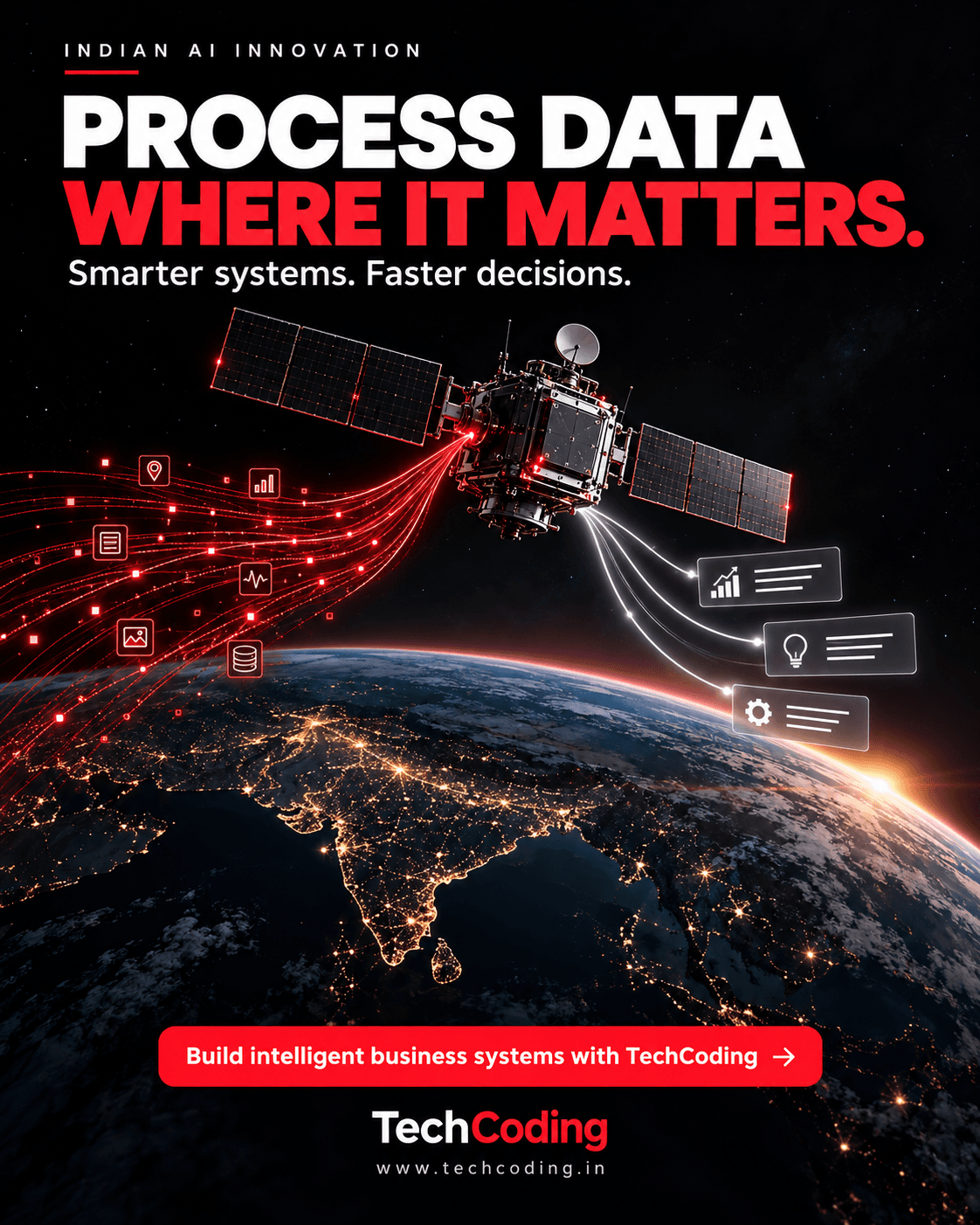
A planned Indian satellite mission illustrates an important shift in how modern technology systems are being designed.
TakeMe2Space is preparing to launch MOI-1A, a sub-50 kg satellite carrying edge-computing hardware. Customers will be able to upload containerised AI models, process selected satellite data in orbit and receive the resulting analysis rather than the entire raw dataset.
The launch is scheduled for 1 October 2026. Therefore, it should currently be treated as a planned deployment—not a completed operational success. reuters.com
Even at this stage, the underlying architecture offers a useful lesson for businesses.
The real problem is not a shortage of data
Most companies already generate large volumes of information through websites, CRM systems, sales conversations, lending applications, support requests and internal operations.
The difficulty is converting that information into timely action.
A sales team may have thousands of leads but no consistent qualification process. An NBFC may collect every required document but still depend on manual follow-ups. Management may have several dashboards without knowing which exception needs attention first.
Adding another reporting tool does not necessarily solve these problems.
Process information closer to the decision
Orbital computing is an example of edge processing: information is analysed near the place where it originates, and a smaller, more useful result is sent onward.
Businesses can apply the same principle without launching anything into space.
For example:
A website can qualify an enquiry before creating a CRM opportunity.
A lending system can validate documents as they are submitted.
A CRM can identify inactive high-value leads automatically.
An operations platform can alert managers only when a threshold is breached.
An AI assistant can summarise a customer’s history before an employee responds.
The objective is not to remove every human decision. It is to reduce avoidable waiting, repetition and information overload.
Start with the decision, not the AI model
Before implementing AI automation, define the business decision that should improve.
Ask:
Which workflow is currently slow or inconsistent?
What information is required to make the decision?
Where is that information created?
Which steps can safely be automated?
When must a person review the result?
How will success be measured?
Useful measures may include response time, approval turnaround time, conversion rate, processing cost, exception rate and customer satisfaction.
This outcome-led approach is increasingly important as organisations scrutinise the cost and measurable returns of enterprise AI. financialexpress.com
Three practical applications
CRM automation
AI can classify enquiries, summarise conversations, recommend follow-ups and identify stalled opportunities. The output should appear inside the salesperson’s existing workflow instead of requiring another disconnected tool.
NBFC lending workflows
Automation can assist with application capture, document completeness, policy checks, communication and case prioritisation. Credit decisions must remain governed, explainable and subject to the lender’s approved policies.
Operational intelligence
Companies can connect ERP, CRM and service data to detect anomalies and generate decision-ready alerts. This is more useful than sending managers every underlying record.
Governance must be designed from the beginning
Automated systems need defined permissions, audit logs, data protection, escalation rules and human oversight.
This is particularly important for lending, financial services and other regulated workflows. A fast system that cannot explain its actions introduces risk rather than value.
From raw data to practical action
TakeMe2Space’s planned mission is an ambitious example of processing data where it is generated. For ordinary businesses, the same idea can be applied through well-designed websites, connected CRM platforms, workflow automation and responsible AI.
The opportunity is not simply to collect more information.
It is to deliver the right insight to the right person at the right time.
TechCoding builds connected digital systems for websites, CRM, lending operations and business automation. Visit www.techcoding.in to explore how your existing workflows can be converted into measurable, intelligent processes.